Photo: Ladnaan Media
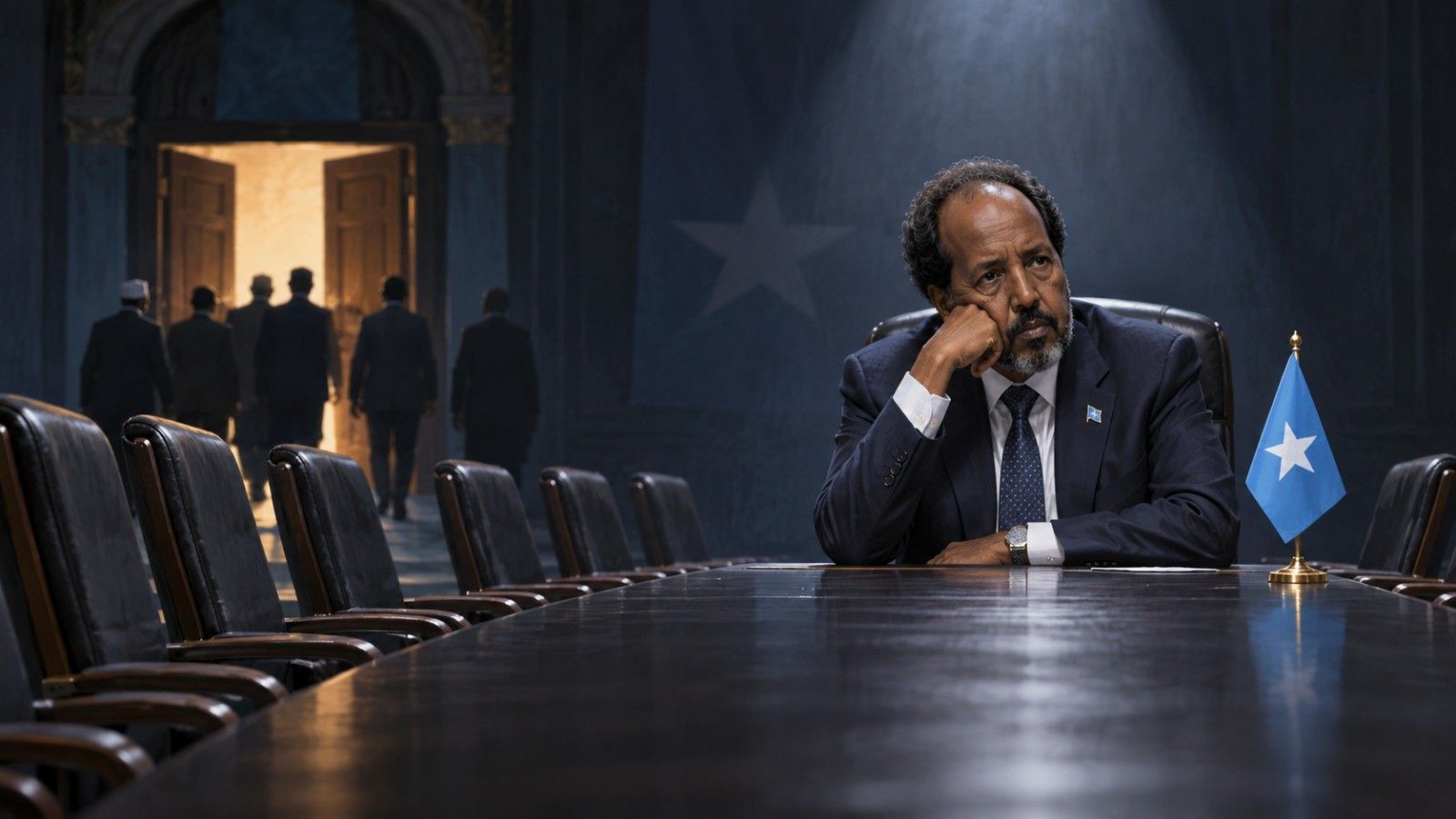
Somalia's president, Hassan Sheikh Mohamud, is politically isolated, both inside the country and beyond its borders. That is my assessment after following the country's politics closely, and it is the argument of this column.
A leader is isolated when the people he needs stop standing with him. These include political partners, leaders across the country, ordinary citizens, and friends abroad. Nobody announces such a moment. It shows up in how far a government's authority actually reaches and in how few people are still willing to defend its choices. By that measure, I believe the president's position today is very weak.
The echo of 1990
Those who lived through the final years of Mohamed Siad Barre will recognise the pattern. By 1990, he had dug in. He rejected advice and refused to listen to those urging him to change course. His administration, once national in reach, shrank until it was effectively confined to Villa Somalia.
I draw that comparison deliberately. In my view, Somalia's present leadership has followed the same path. It has hardened its position, turned away counsel, and ended up governing from little more than the walls of the presidential compound. The 1990 comparison is my judgment, not a claim that the two situations are identical in every detail. But the direction of travel is the same, and so is the danger.
A government that stops listening does not become stronger. It becomes smaller.
A record that history will weigh
In my opinion, Hassan Sheikh will be remembered as Somalia's worst president, once the record is examined in full. I base that judgment on what I see as serious wrongs committed against Somalis and against the constitution the country agreed on to hold itself together.
The list, as I see it, is long: the displacement of people from their homes, the seizure of land, the abuse of official power, the breaking of the law and the drift towards one-man rule. Each of these damages public trust. Together they have eroded the basis on which Somalis agreed to live under a common order.
The constitution matters here because it was not written for one man or one term. It was an agreement among Somalis, reached with great difficulty, about how power is to be shared, limited, and handed over. When a president treats that agreement as an obstacle rather than a duty, he is not simply bending a rule. He is breaking a promise made to the whole country.
Where this leaves the country
The best proof of my argument, I believe, is where Somalia stands today. A president who should be the visible centre of national unity governs from a single compound. That is the real measure of his isolation.
Somalis have seen this story before, and they know how it ends. Power that rests on narrowing circles of loyalty, rather than on consent and the law, does not last. The cost of its collapse is paid not by the men in the compound but by ordinary people, who are the ones displaced, dispossessed, and left without protection.
The lesson of 1990 is not complicated. A leader who ignores his own people and the rules they agreed on ends up alone. It is not too late for those in power to listen, but time is running out.
Ladnaan Media invites the president's office to respond to the points raised in this column.